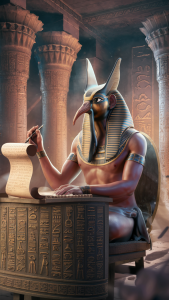
“Thoth: The Divine Scribe of Wisdom and Knowledge.”
Introduction
Thoth is an ancient Egyptian deity associated with wisdom, writing, and knowledge. He is often depicted as a man with the head of an ibis or a baboon. Thoth played a significant role in Egyptian mythology and was considered the scribe of the gods, responsible for maintaining the balance of the universe and recording the deeds of humans. He was also associated with magic, science, and the arts.
Thoth: The God of Wisdom and Writing in Ancient Egypt
Thoth: The God of Wisdom and Writing in Ancient Egypt
In the pantheon of ancient Egyptian gods, Thoth held a prominent position as the deity of wisdom, writing, and knowledge. Known as the “scribe of the gods,” Thoth played a crucial role in the development of Egyptian civilization and its written language. This article explores the significance of Thoth in ancient Egyptian culture and sheds light on his various roles and attributes.
Thoth was often depicted as a man with the head of an ibis or a baboon, symbolizing his association with wisdom and intelligence. He was believed to be the inventor of writing and the patron god of scribes, making him a central figure in the dissemination of knowledge and the preservation of historical records. The ancient Egyptians revered Thoth as the divine mediator between the gods and humans, as well as the judge of the dead.
One of Thoth’s most important roles was that of the “measurer of time.” He was responsible for maintaining the cosmic order and ensuring the regularity of the seasons and the annual flooding of the Nile River. This connection to time and order made Thoth an essential deity in the Egyptian belief system, as the stability of their agricultural society depended on the predictability of natural cycles.
Thoth’s association with writing and knowledge extended beyond the earthly realm. He was believed to have recorded the verdicts of the gods and the deeds of humans in the “Book of Thoth,” a sacred text that contained the secrets of the universe. This book was said to grant its possessor immense power and wisdom, making it a coveted object among both mortals and gods.
As the god of writing, Thoth was also responsible for the invention of hieroglyphics, the ancient Egyptian writing system. Hieroglyphics consisted of a complex combination of pictorial symbols and phonetic signs, allowing for the expression of both concrete and abstract concepts. Thoth’s role in the development of this writing system was crucial in the advancement of Egyptian civilization, as it enabled the recording of historical events, religious rituals, and scientific knowledge.
Thoth’s influence extended beyond the realm of writing and knowledge. He was also associated with magic and healing, often depicted with a staff entwined by two serpents, symbolizing his ability to restore balance and cure diseases. Thoth was considered the patron god of doctors and healers, and his wisdom was sought after in matters of medicine and herbal remedies.
In addition to his intellectual and healing attributes, Thoth was also revered as a protector of the dead. He guided souls through the perilous journey of the afterlife, ensuring their safe passage to the realm of Osiris, the god of the underworld. Thoth’s role as a psychopomp, or guide of souls, highlights his importance in Egyptian funerary rituals and beliefs surrounding the afterlife.
In conclusion, Thoth played a vital role in ancient Egyptian culture as the god of wisdom, writing, and knowledge. His association with writing and the invention of hieroglyphics revolutionized the way Egyptians communicated and recorded their history. Thoth’s influence extended beyond intellectual pursuits, as he was also revered as a healer, protector of the dead, and the measurer of time. The legacy of Thoth continues to resonate in modern times, as his wisdom and intellectual prowess remain an inspiration for seekers of knowledge and understanding.
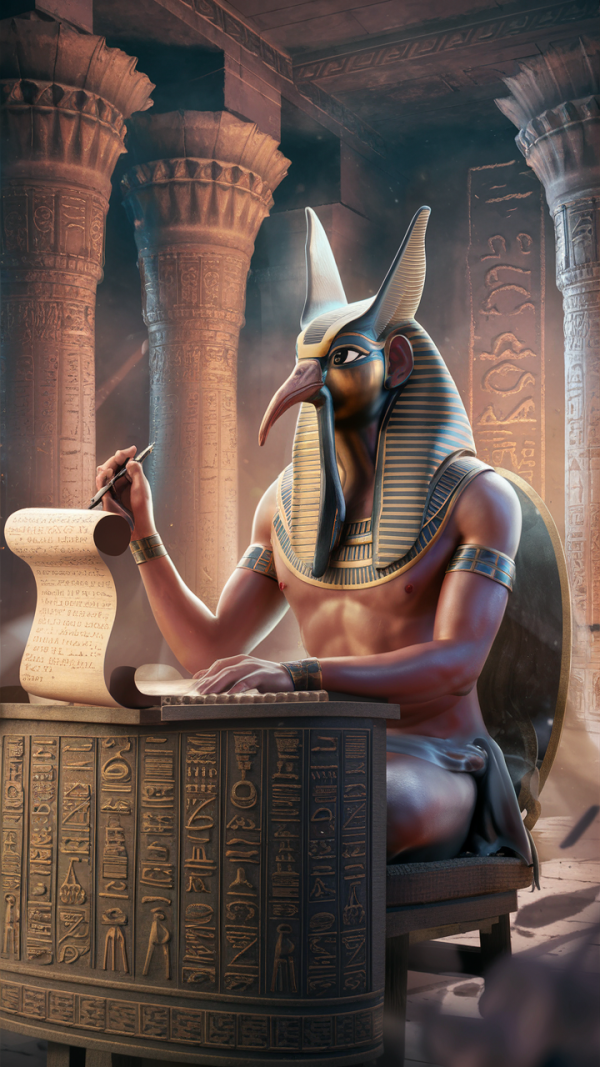
A stunning 3D render of the ancient Egyptian god Thoth, seated on a rocky surface with a quill in one hand and a papyrus scroll in the other. Thoth, adorned with the head of an ibis, gazes thoughtfully into the distance. Behind him, a vast desert landscape stretches out, with pyramids and hieroglyphics etched into the ground. The scene is bathed in a golden glow, highlighting the intricate details of Thoth’s divine form.
The Mythology and Symbolism of Egyptian God Thoth.
In the rich tapestry of ancient Egyptian mythology, one deity stands out for his wisdom, knowledge, and influence over various domains. This deity is Thoth, the god of writing, magic, and wisdom. Thoth, also known as Djehuty, played a significant role in Egyptian cosmology and was revered as one of the most important gods in their pantheon.
Thoth’s origins can be traced back to the earliest periods of Egyptian history. He was believed to be the son of the creator god, Ra, and the goddess of the sky, Nut. As the god of writing and knowledge, Thoth was often depicted with the head of an ibis, a bird associated with wisdom and learning. This unique representation symbolized his role as the scribe of the gods and the inventor of writing.
One of the most famous myths surrounding Thoth is his involvement in the judgment of the deceased. According to Egyptian beliefs, after death, the soul would stand before the god Osiris, who would weigh their heart against the feather of Ma’at, the goddess of truth and justice. Thoth played a crucial role in this process, recording the results and ensuring fairness in the judgment. His presence in this myth highlights his role as a mediator and a guardian of cosmic order.
Thoth’s association with writing and knowledge extended beyond the realm of the gods. He was also believed to have given humanity the gift of hieroglyphic writing, which allowed the Egyptians to record their history, religious texts, and everyday life. This invention revolutionized Egyptian society, enabling the preservation and transmission of knowledge across generations. Thoth’s influence on writing and language made him a patron deity of scribes, scholars, and intellectuals.
In addition to his role as a scribe, Thoth was also revered as a powerful magician. He was believed to possess the knowledge of spells and incantations that could manipulate the forces of nature. Thoth’s magical abilities were often depicted in Egyptian art, where he was shown holding a staff or an ankh, symbols of his authority over magic and life. His association with magic made him a popular deity among those seeking protection, healing, and guidance.
Thoth’s influence extended beyond writing and magic. He was also associated with the moon, which was believed to be his eye. The moon’s waxing and waning cycles mirrored Thoth’s role as a mediator between light and darkness, order and chaos. This connection to the moon further emphasized his role as a deity of balance and harmony.
Throughout Egyptian history, Thoth’s influence remained strong. His wisdom and knowledge were sought after by pharaohs and commoners alike. Temples dedicated to Thoth were built across Egypt, and his cult grew in popularity. The city of Hermopolis Magna, located in Upper Egypt, was particularly associated with Thoth and served as a center for his worship.
In conclusion, Thoth, the Egyptian god of writing, magic, and wisdom, played a significant role in ancient Egyptian mythology. His association with writing, knowledge, and judgment made him a revered deity among the Egyptians. Thoth’s influence extended beyond the realm of the gods, as he was believed to have given humanity the gift of writing and was revered as a powerful magician. His association with the moon further emphasized his role as a deity of balance and harmony. Thoth’s legacy continues to captivate scholars and enthusiasts, reminding us of the profound impact of ancient Egyptian mythology on human civilization.